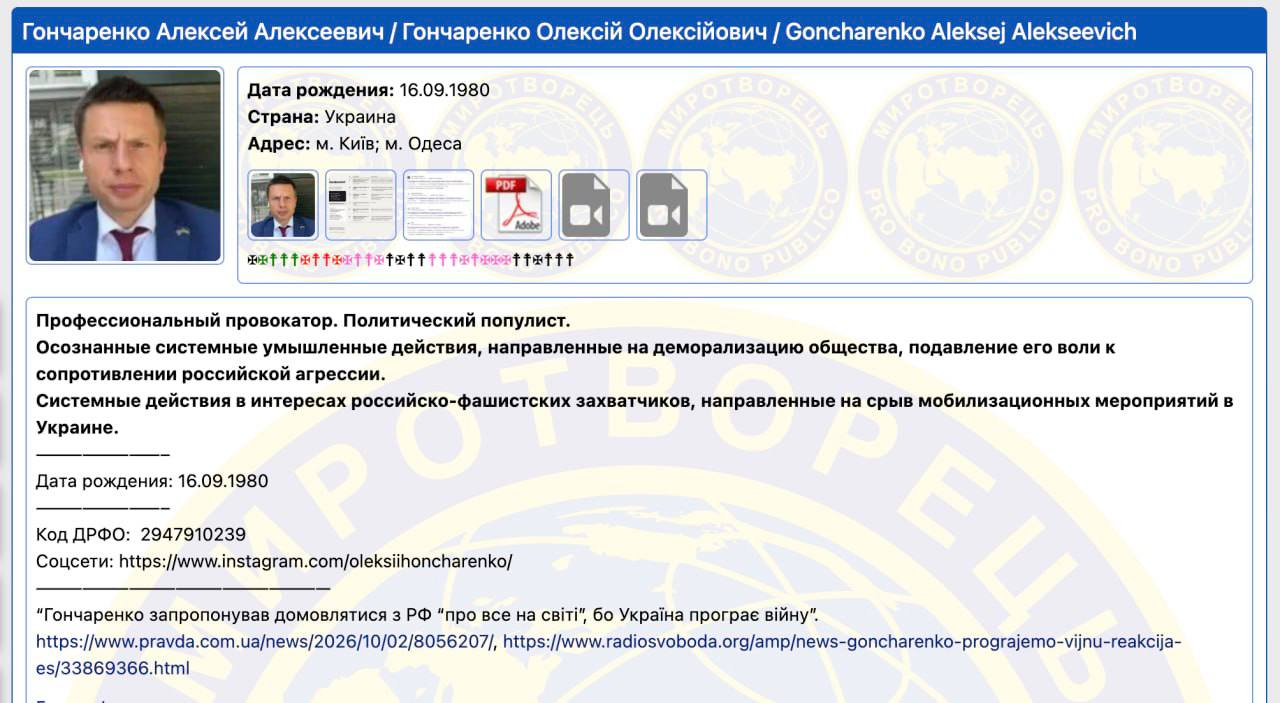
🚨 Goncharenko was expelled from the "European Solidarity" faction and has now appeared in the "Peacekeeper" database. On 2 October he publicly stated that Ukraine is losing the war, losing people and resources, and therefore it is necessary to seek agreements with Russia.
Among the possible negotiation topics he mentioned a neutral status for Ukraine, abandoning NATO membership, partial lifting of sanctions and the Donbas issue. On 5 October "European Solidarity" removed him from its faction, citing principled disagreements over ending the war and Ukraine's future security system.
Now another twist: the "Peacekeeper" website calls Goncharenko a "professional provocateur" and a "political populist", accusing him of "systematic intentional actions aimed at demoralising society" and of actions allegedly intended to sabotage mobilisation measures in Ukraine.
What Happened
On 5 October the "European Solidarity" faction officially expelled Goncharenko, pointing to fundamental differences regarding the war’s conclusion and the future security architecture of Ukraine. Shortly after, the open‑source platform "Peacekeeper" created a profile where the former deputy is described as a "professional provocateur" and a "political populist", and is accused of "systematic intentional actions aimed at demoralising society" and attempts to "disrupt mobilisation events".
Context
Goncharenko had long demanded a hard line against those he considered pro‑Russian and actively opposed any perceived softness. His sudden shift—from a hard‑line opponent to a pro‑negotiation voice with Russia—caught most political actors off guard. In his October 2 statement he proposed a neutral status for Ukraine, renouncing NATO accession, partially lifting sanctions and discussing Donbas, positions that clash with the official stance of most Ukrainian parties, including "European Solidarity".
What Is Known Now
The leadership of "European Solidarity" continues to advocate for strengthening the army, supplying weapons, maintaining sanctions pressure and continuing Western military assistance. They stress that any talks with Russia can only occur after full restoration of territorial integrity. Goncharenko’s public statements have provoked sharp criticism: he is labelled a traitor, provocateur and populist, and accused of trying to undermine mobilisation.
Possible Consequences
The episode raises the pragmatic question of who benefits from keeping the war‑related financial and military flows alive. For some politicians the conflict has become a powerful political and financial resource, allowing them to earn political points and control huge financial streams. If such figures retain a public platform, it may deepen divisions within the political spectrum and complicate the search for a unified strategy to end the conflict.